Four years of heritage augmented reality — our lessons learned
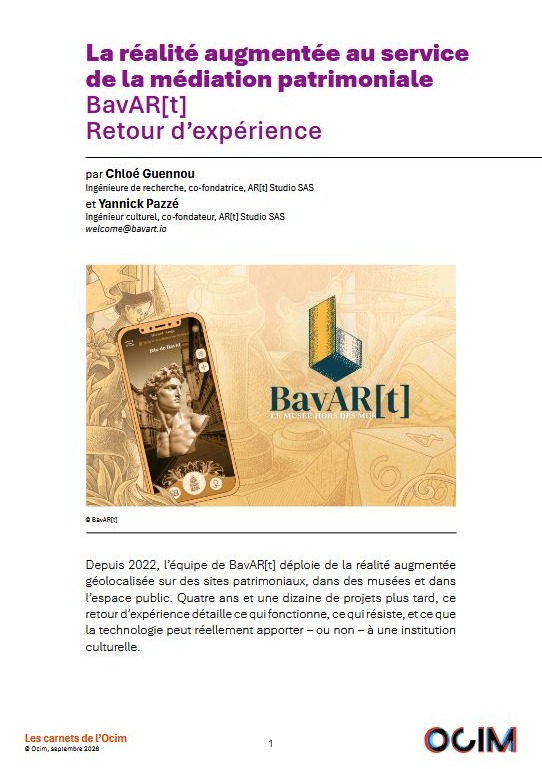
[Press] What actually works when you deploy augmented reality in a museum or heritage site? What struggles? And what can technology really bring to a cultural institution — or not?
That’s the subject of our retrospective, published in Les Carnets de l’Ocim (Office de Coopération et d’Information Muséales), the reference journal for museum and science-culture professionals in France.
We look back at four years and around ten BavAR[t] projects, through three concrete case studies:
🎖️ In the Shoes of a Zouave — an off-site collection co-built with Université Rennes 2 and the Musée de Bretagne.
🚉 En Gare (“At the Station”) — the national network led by ONaCVG (French Ministry of Defence), in partnership with SNCF Gares & Connexions, connecting five train stations to major sites of national memory.
🏰 Château d’Artigny & Spa’Artigny — a monumental fresco that comes back to life under the visitor’s smartphone.
We also discuss what technology alone doesn’t solve: editorial co-construction, local/territorial anchoring, building skills in-house, the long-term sustainability of digital content, and the balance between augmented and human-led mediation.
The article closes with five questions to ask yourself before launching this kind of project.
👉 Read the full article on the Ocim website (lien : https://www.ocim.fr/ocimotheque/les-carnets-de-locim/realite-augmentee-mediation-patrimoniale-bavart-retour-experience)
Thank you to the whole Ocim team for the invitation to write this!